
Maintenance & Care · 16 min read
How to clean roller blinds Australia: maintenance and warranty guide
Chris & Campbell · 26 June 2026
What's the right way to clean roller blinds in a dusty Wagga summer without wrecking the coating? After fifteen years measuring jobs across the Riverina, the same question lands every week. The honest answer to how to clean roller blinds Australia comes down to three things: a sensible schedule, the right products, and the warnings buried in your manufacturer warranty. Get those wrong and a $400 blind dies in three years instead of fifteen.
A maintenance schedule: how to clean roller blinds Australia by treatment type
Most Australian blind and shutter manufacturers recommend a light dust weekly and a full damp-wipe every three to six months. That schedule protects the UV-stable topcoat on PVC and fabric. Skip it for a year and embedded grit grinds the coating off each time the blind rolls up or the louvre tilts.
In the Riverina, the maintenance interval shrinks. Bureau of Meteorology Wagga Wagga climate data shows extended hot, dry stretches that pull dust off paddocks and into homes. Cropping dust, tile dust, and Riverina red soil all settle on horizontal surfaces, and tilted louvres or rolled-up roller fabric is the first thing they coat. Add wood-heater smoke through winter and the load roughly doubles versus a coastal home.
When working out how to clean roller blinds Australia by room, a practical schedule for an average NSW household looks like this: vacuum or feather-dust every blind weekly, damp-wipe high-traffic rooms (kitchen, living, bathroom) every 6 to 8 weeks, and damp-wipe bedrooms every 12 to 16 weeks. Outdoor zipscreens and awnings get hosed quarterly and inspected for spider build-up before each season. For climate-driven planning, see our Temora extreme climate guide.
For a closer look at this, see Vertical Blinds for Sliding Doors: What NSW Homeowners Need to Know.
For a closer look at this, see Motorised blinds Australia: are smart window coverings worth the cost?.
For a closer look at this, see Plantation Shutters vs Roller Blinds: Which Suits Your NSW Home?.
For a closer look at this, see Motorised blinds Australia: Smart home integration guide for 2026.
For a closer look at this, see Roman blinds vs curtains Australia: which suits your living room?.
For a closer look at this, see Bathroom blinds Australia moisture resistant: what actually lasts.
For a closer look at this, see How to choose roller blinds: The Australian homeowner's guide.
For a closer look at this, see Moisture-resistant blinds for bathrooms: what works best in Australia.
Safe products and methods: how to clean roller blinds Australia without voiding a warranty
Warm water with a few drops of pH-neutral dish soap on a microfibre cloth cleans roughly 90% of household blinds and shutters without risk. Mastering how to clean roller blinds Australia really starts with what NOT to put on them: ammonia, bleach, citrus solvents, and abrasive pads all attack the protective coating.
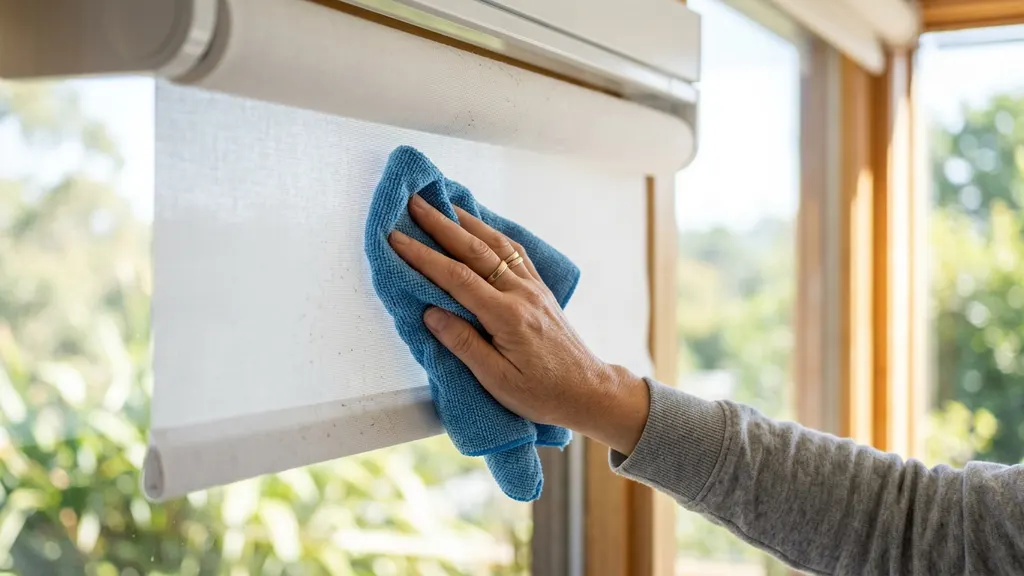
For fabric roller blinds, vacuum first with a soft brush attachment on the lowest suction setting. Roll the blind down fully so the entire fabric face is exposed. Work top to bottom in long vertical strokes, never circles. Spot-clean marks with a barely-damp microfibre cloth in lukewarm water with a single drop of plain dish soap. Blot, never scrub. Let the blind hang fully extended until completely dry before rolling it back up, otherwise trapped moisture grows mildew along the bottom hem.

For PVC roller blind backs and PVC plantation shutters, the same warm soapy water works, plus a soft toothbrush for the corners where the bottom rail meets the fabric. Avoid eucalyptus oil, methylated spirits, and any wood-cleaning sprays containing silicone, which leave a film that attracts dust. The Sustainability Victoria safer cleaning products guide covers which household chemicals are safe to use indoors and which are not. Stick to those products and how to clean roller blinds Australia stops being complicated.
For a closer look at this, see Child safe blinds Australia: cordless options for family homes.
How to clean plantation shutter louvres without damaging the finish
Norman Shutters' care documentation flags painted basswood louvres as vulnerable to joint swelling the moment any wet cleaning method is applied, which is the single biggest practical difference between shutter care and roller blind care. A barely-damp cloth is the ceiling, not a wet one: dust each slat with a microfibre mitt along the grain, spot-clean marks with a cloth wrung almost dry, and follow with a second dry cloth to pull residual moisture off the finish before it reaches a joint.
Start at the top louvre and work down so falling dust lands on slats you haven't done yet. Tilt the louvres fully open, run the mitt along the top surface in one direction, then tilt fully closed and do the bottom surface. The frame, stiles, and tilt rod attract more dust than people expect because they're vertical and hand-touched. A monthly wipe of the tilt rod alone keeps fingerprints off the paint.
Timber shutters demand the most restraint because they absorb water from a wet cloth and swell at the joints, leaving you with louvres that no longer rotate smoothly. The basics of how to clean roller blinds Australia apply to plantation shutter louvres too, but with a tighter water tolerance. For deeper guidance see our plantation shutter cleaning guide, and the timber vs PVC comparison explains why a PVC louvre tolerates a damp wipe that would ruin a basswood one.
Cleaning mistakes that void warranties: how to clean roller blinds Australia the right way
Luxaflex and Norman Shutters both publish lists of named products that immediately void coverage across their roller blind and shutter ranges, and those lists overlap almost entirely: ammonia, bleach, methylated spirits, eucalyptus oil, citrus solvents, abrasive scourers, and steam cleaners. Knowing how to clean roller blinds Australia the right way means reading those lists before reaching for a bottle, not after a cleaning hack strips the topcoat off a louvre panel.
We learned this the hard way early in our careers. A customer in Griffith called us after cleaning her Norman PVC shutters with an ammonia-based glass cleaner she used on every hard surface in her house. The topcoat had gone from six louvre panels within a fortnight. Norman's distributor confirmed the warranty was void and quoted full panel replacement. As Luxaflex and Norman accredited installers, we see this pattern repeat across the Riverina every season, which is why we now laminate the manufacturer care card to every bracket we fit.
Ammonia-based cleaners applied to PVC or painted timber shutters strip protective topcoats. That action is listed explicitly as warranty-voiding in the terms and conditions of major Australian suppliers including Luxaflex and Norman Shutters. Steam cleaners pose the same problem in a different way: high-temperature water vapour breaks down adhesives in roller-blind hems and lifts paint from MDF or HDF shutter cores. The Australian Government YourHome window coverings guide covers the broader trade-offs between treatment types and reinforces the manufacturer-care approach.
The other trap people fall into is removing the fabric from a roller-blind tube to wash it in a machine. The fabric is bonded to a stiffening backing that delaminates in water above 30°C. The blind will rehang crooked and the manufacturer will not honour a replacement. Read the care card stapled to the bracket on the day of install. If you've lost it, search the brand name and "care guide" on the manufacturer's website; every major Australian supplier publishes one. For child-safety implications when re-fitting cords or chains, our child-safe blinds Australia guide covers the AS/NZS rules.
When professional blind cleaning beats DIY in the Riverina
Professional blind cleaning makes sense when a treatment is heavily soiled, fitted somewhere you cannot reach safely, or made from a fabric you cannot get wet at home. Capital-city services charged $35 to $75 per blind for ultrasonic or injection-extraction work in 2026, well below the cost of replacement (see Canstar Blue's window covering directory for service-provider listings).
Ultrasonic cleaning uses a tank of warm water and high-frequency vibration to lift embedded dust from venetian and roller fabrics without scrubbing. Injection-extraction is closer to upholstery cleaning: a cleaning agent is sprayed onto the blind and vacuumed back out within seconds, so the fabric barely gets wet. Both are gentle enough that manufacturers like Luxaflex list approved professional services as warranty-compliant.
| Cleaning approach | Best for | Cost per blind |
|---|---|---|
| DIY damp-wipe | Most fabric and PVC blinds, light soiling | $0 to $5 in materials |
| Ultrasonic (on-site) | Venetians, heavily-soiled rollers | $45 to $75 |
| Injection-extraction | Delicate fabric rollers, screen blinds | $40 to $65 |
| Pickup & return | High-rise or hard-access installs | $40 to $60 plus transport |

Even with a pro doing the deep work, knowing how to clean roller blinds Australia between visits still falls on the homeowner. For a typical Riverina home of 15 blinds, a full professional service runs roughly $600 to $1,100 every 18 to 24 months, which is reasonable if you have allergy sufferers in the house or if a tenant has handed back a property with kitchen-grease damage. Landlords managing rental properties should compare cleaning costs against full replacement at handover; our NSW rental property window treatments guide covers the bond-deduction side.
Frequently asked questions
How often should I clean my roller blinds in Australia?
Most Australian manufacturers recommend a light dust weekly and a full damp-wipe every three to six months on roller blinds, with bathrooms and kitchens shortened to roughly six to eight weeks because of steam and cooking-oil deposits. In the Riverina, the dry summer dust load means tilting that schedule slightly tighter still pays off. The Australian Government YourHome guide to window coverings reinforces that regular dusting protects UV-stable coatings. Understanding how to clean roller blinds Australia comes down to consistency more than chemistry, and skipping the routine for a year will shave years off the working life of the fabric.
Can I use a vacuum cleaner on plantation shutters?
Yes, with the right attachment. A soft-bristled brush head on the lowest suction setting lifts dust off painted timber and PVC louvres without scratching the finish. Hold the brush parallel to the louvre and stroke along the grain, never across it. Avoid hard plastic crevice tools on painted shutters, since they will mark the topcoat the moment your hand slips. The CSIRO research on indoor air quality notes that regular dry vacuuming of horizontal household surfaces is one of the simplest interventions for reducing settled-dust allergens at home, and that benefit applies to louvres too.
Are vinegar and dish soap safe for fabric roller blinds?
Diluted pH-neutral dish soap is safe. Vinegar is risky. White vinegar at full strength is mildly acidic and will progressively dull the UV-protective topcoat on coated fabric and PVC, even though it appears harmless after the first clean. If you must use vinegar to lift a mineral stain, dilute it to one part vinegar to ten parts water, spot-test on a hidden corner first, rinse with plain water, and dry immediately. The Sustainability Victoria safer cleaning products page outlines which household chemicals are gentler on coated surfaces.
What cleaning products will void my shutter warranty?
Ammonia-based glass cleaners, bleach, methylated spirits, eucalyptus oil, citrus solvents, and abrasive scourers are explicitly listed as warranty-voiding products by major Australian suppliers including Luxaflex and Norman Shutters. Steam cleaners are also banned because high-temperature vapour breaks down topcoats and adhesives. Always read the care card supplied with your install, or pull the current version off the manufacturer's website. When in doubt about how to clean roller blinds Australia safely, default to manufacturer-supplied care guidance rather than a generic household tip.
How much does professional blind cleaning cost in Australia?
Professional in-home blind cleaning services in Australian capital cities charged between $35 and $75 per blind for ultrasonic or injection-extraction cleaning in 2026, according to service listings across Sydney, Melbourne, and Brisbane. Regional NSW pricing tends to sit slightly higher because of travel surcharges, but pickup-and-return services can offset that by bundling jobs. The Canstar Blue blinds and curtains directory is a reasonable starting point for finding local providers and seeing comparative reviews before you book.
Can I take roller blind fabric off the tube and machine wash it?
No. The fabric on a modern roller blind is bonded to a stiffening backer, and machine washing delaminates that backing, leaving the fabric warped and unable to roll evenly. The blind will rehang crooked and the manufacturer will not replace it under warranty. If a fabric is so badly stained that surface cleaning fails, the safer path is a professional injection-extraction clean by a service approved by the brand, or replacement of the fabric on the existing tube using a like-for-like roll. Ask the original supplier for an approved cleaning technician before attempting any method that gets the fabric wet beyond a spot-clean.


