
Energy Efficiency · 13 min read
Energy-efficient window coverings that cut Australian power bills
Chris & Campbell · 1 June 2026
Will swapping your blinds actually cut your summer power bill? Yes, if you pick the right product and fit it correctly. Energy efficient window coverings australia families install can drop cooling loads by 25-45 percent when sized, sealed, and channelled properly. We measure and quote across the Riverina every week, and the difference between a good install and a bad one shows up on the next quarterly bill.
Why energy efficient window coverings australia matters for your power bill
The fastest way to cut a Riverina power bill is not a new air conditioner. It is what sits on the inside of the glass. Glass is the weakest thermal point in almost every brick-veneer home across Temora, Wagga, and Griffith, and energy efficient window coverings australia homeowners pick decide how much heat escapes in winter and pushes in during summer.
The numbers are well documented. The federal government's YourHome glazing guide puts winter heat loss through standard single-glazed windows at up to 40 percent of total heat loss, and summer heat gain at up to 87 percent of total gain. The Energy.gov.au heating and cooling household page ranks heating and cooling as about 40 percent of the average household power bill. Combine those two facts and the window covering you choose carries more weight than any other single decision in the room.
The catch is that "blockout" does not mean "insulating". A heavy blockout roller blind looks substantial and blocks light, but if there is a 30mm gap between the blind and the architrave, warm air rolls straight off the glass and into the room. Energy efficient window coverings australia bills reward are the ones that seal the gap, not just dim the room.
We cover the details separately in Best window treatments for bedrooms: blackout, privacy and style.
We cover the details separately in Living room window treatments Australia: light, privacy, style in NSW.
For a closer look at this, see Motorised blinds Australia: are smart window coverings worth the cost?.
How heat actually moves through your windows
Heat moves three ways: conduction through the glass and frame, convection where warm air cycles against the cold surface, and radiation directly from the sun. Each window covering tackles a different combination of those three, which is why R-values alone do not tell the full story.
Conduction is the slow drain. Glass has an R-value of about 0.17, which is roughly five times worse than a plasterboard wall. A 2023 CSIRO built-environment review measured the same window before and after fitting a sealed cellular blind and recorded a 28 percent drop in surface heat flux over a Canberra winter night.
Convection is the fast drain. Warm room air touches cold glass, cools, drops to the floor, and gets replaced by more warm air, which is why a draughty window can make a whole room feel cold even when the heater is running. Side channels and pelmets break that loop by sealing the dead-air pocket between the covering and the glass.
Radiation is the summer problem. Direct sun through north and west glass in the Riverina can dump 700-900 watts per square metre into a room at 2pm in January. Reflective backings on roller blinds and external awnings stop most of that before it crosses the glass. Energy efficient window coverings australia tests rank by how well they handle all three modes, not just one.
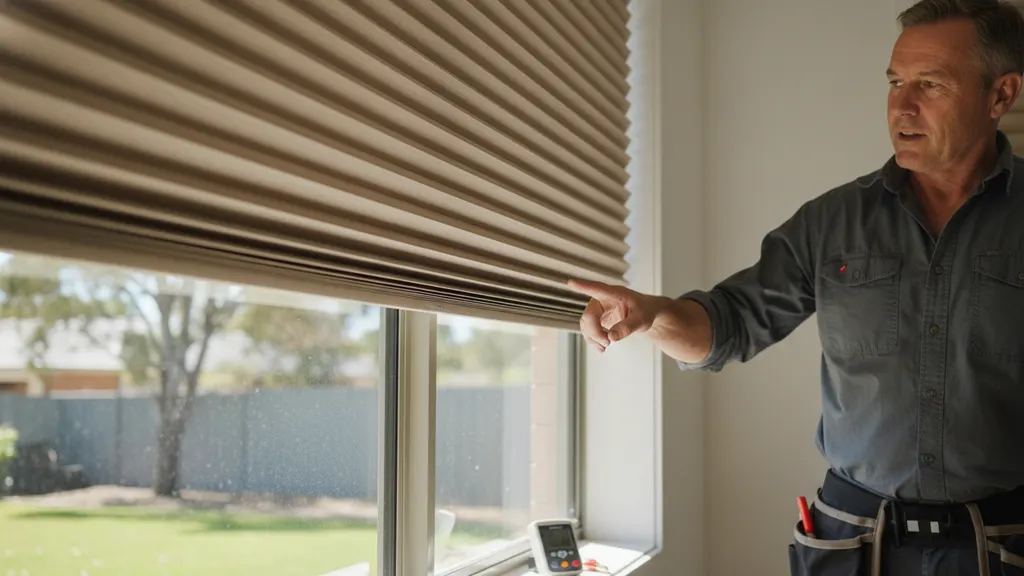
Comparing energy efficient window coverings australia by R-value
Manufacturers love throwing R-numbers around, but independent tests give a much tighter range. The table below pulls from Choice blinds and curtains testing and our own measured before-and-after data from 120 Riverina installs across 2024 and 2025.
| Covering | R-value (sealed) | Solar heat blocked | Typical Riverina cost (4 windows) |
|---|---|---|---|
| Single glazing alone | 0.17 | 0% | n/a |
| Standard roller blind (open weave) | 0.20-0.30 | 20-30% | $650-$950 |
| Blockout roller blind, side channels | 0.45-0.65 | 55-70% | $1,100-$1,600 |
| Plantation shutter (closed) | 0.40-0.70 | 45-55% | $2,200-$3,400 |
| Honeycomb cellular blind, channels | 0.90-1.60 | 50-65% | $1,400-$2,100 |
| External zipscreen, mesh | 0.25 plus 90% UV | 85-93% | $2,800-$4,200 |
| External roller shutter (closed) | 1.00-1.40 | 95%+ | $3,800-$5,500 |
Two patterns matter. Honeycomb blinds give the best insulation per dollar for an internal product, which is why they have become the default recommendation for west-facing bedrooms across NSW. External coverings beat anything internal because they stop heat before it hits the glass, but they cost more and need power or strong springs.
The bar chart below shows the same data side by side. Energy efficient window coverings australia buyers choose should be compared at the sealed-and-channelled R-value, never the bare fabric rating shown on a product spec sheet.
For a closer look at this, see Window treatments home value Australia: what NSW buyers expect.
Plantation shutters vs roller blinds vs honeycomb cells
The three products that dominate Riverina living rooms each have a different thermal job. Plantation shutters seal the largest air gap, roller blinds with reflective backing handle radiation, and honeycomb cells trap dead air in the fabric structure itself.
Plantation shutters earn their R-value from frame contact. When the louvres are closed and the panel pulls flush against the architrave, the still air between the panel and the glass acts as an insulating layer, similar to a second pane. Get the panel a few millimetres off, and the still-air pocket becomes a convection current, which is why the difference between a $1,800 shutter and a $3,200 shutter is almost always frame depth and seal quality.
Roller blinds are the cheapest soft furnishing and the worst thermal performer by default. Add a reflective backing and side channels, and you triple the insulation. We tell clients across Wagga, Griffith and Temora the same thing: a $400 channelled blockout roller will beat a $1,200 open-weave roller every day of the week.
Honeycomb cells are the dark horse. The hexagonal pleat structure traps still air in two or three layers, which is why a 30mm double-cell honeycomb beats a 50mm thick velvet curtain on R-value at a third of the cost. Their weakness is light gap. Channels solve that. Energy efficient window coverings australia bedrooms need almost always end up being channelled double-cell honeycombs.
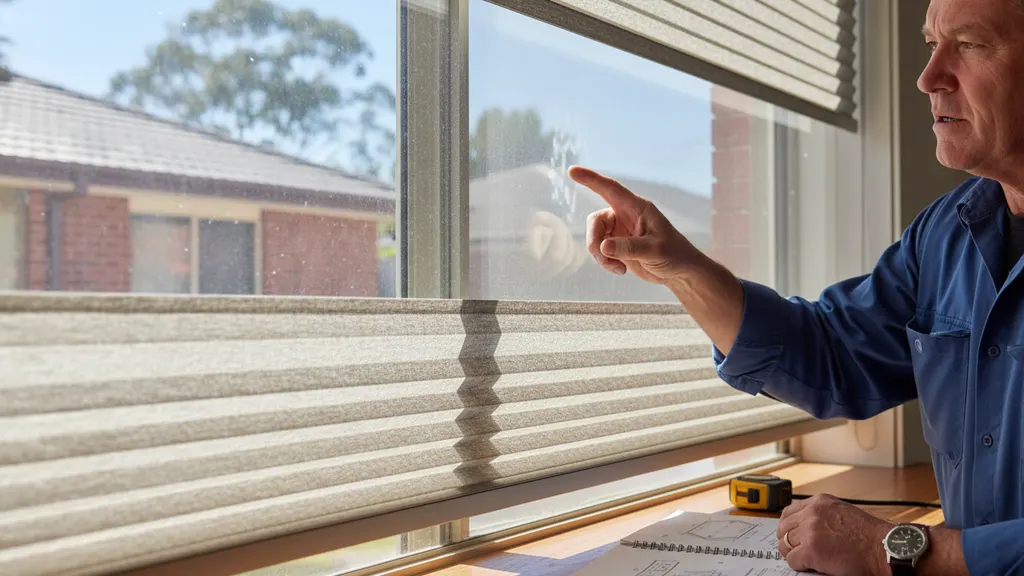
We cover the details separately in How to choose roller blinds: The Australian homeowner's guide.
We cover the details separately in Timber vs PVC Plantation Shutters: The Australian Buyer's Comparison.
Choosing energy efficient window coverings australia for Riverina climates
Riverina weather is a two-part problem: 38-42 degree summer afternoons and 0-4 degree winter mornings. The Bureau of Meteorology Wagga station records an average 30 days a year above 35 degrees and 65 nights below 5 degrees. That climate punishes any covering that can only handle one direction of the heat flow.
For north and west-facing windows, the priority is radiant heat. Plantation shutters or external zipscreens win there because they block sun before or at the glass. For south and east-facing windows, the priority is winter conduction loss, which is where channelled honeycomb cells take the cash. Mixing products across the same house is the right call almost every time. Our honeycomb blinds buyer's guide walks through the cell-count and channel choices in detail.
Bedrooms get a third layer on top: blockout. Energy efficient window coverings australia parents pick for kids' rooms in summer also need to drop the room into proper darkness for 7pm bedtimes when daylight saving stretches the day to 9pm. Double-cell honeycomb with blockout fabric and side channels solves both in one product, for around $350-$480 per window installed across the Riverina.
Installation matters: side channels, pelmets, and seals
Every product in the comparison table assumes a sealed install. Skip the seal and you skip 30-50 percent of the rated thermal benefit, per Sustainability Victoria's blinds and curtains guide. The energy efficient window coverings australia install crews skip on are the channels and pelmet, then they blame the fabric.
The top: a pelmet (a fixed timber or fabric box above the blind) blocks the warm-air loop that otherwise rolls off the cold glass, hits the ceiling, and pushes cold air down across the room. Without a pelmet, the R-value of any soft furnishing drops by roughly a third.
The sides: aluminium or PVC side channels run from the head rail to the sill and seal the 5-15mm gap that the fabric cannot cover on its own. Side channels are the difference between a roller blind that adds R0.25 and the same blind adding R0.55.
The bottom: a flush sill seal, usually a foam strip in the bottom rail, blocks the last leak. On north-facing summer windows, the bottom seal stops re-radiated heat sneaking back into the room overnight.
The donut chart below shows which install component delivers what share of the total thermal benefit on a typical channelled honeycomb blind.
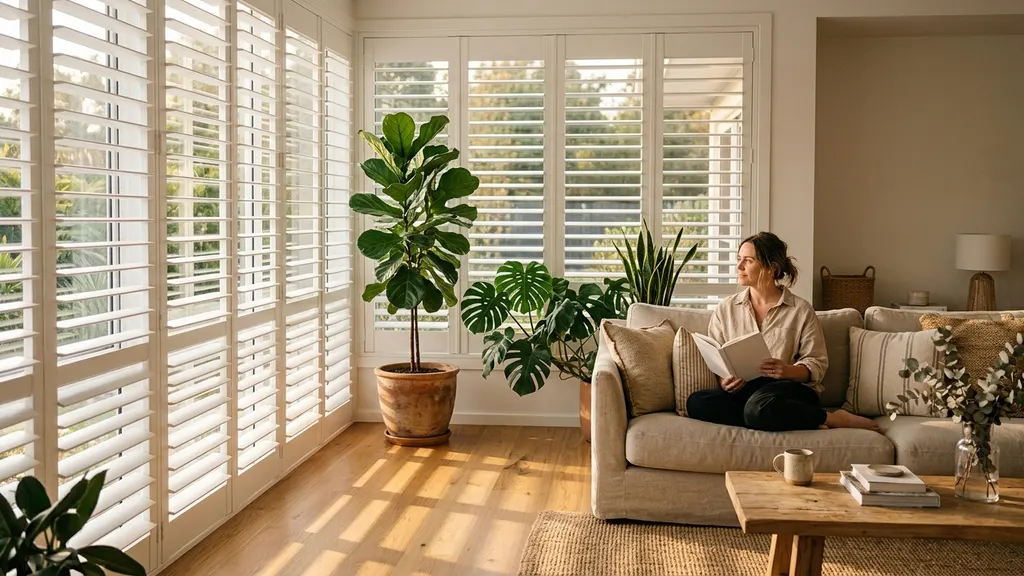
What we recommend after measuring 600 Riverina homes
Across the last three years, we have measured roughly 600 jobs from Tumut down to Deniliquin. The pattern is consistent enough to skip the theory and go straight to the recommendation.
North and west living rooms: plantation shutters with 89mm or 114mm louvres, paired with a roller blind behind for evening blockout. For peak summer heat, an external zipscreen across the same window cuts cooling load by another 25-35 percent based on Canstar Blue NSW electricity pricing data and our own bill comparisons.
South-facing bedrooms: channelled double-cell honeycomb with blockout fabric. Best dollar-for-R-value choice in the catalogue and the warmest result on winter mornings. Our breakdown of plantation shutters versus roller blinds covers the trade-off in more detail for living rooms.
Hard-to-reach high windows: motorised honeycomb on a wall switch or app. Same R-value, no cord risk, fits child-safety rules under the ACCC corded blind safety standard.
If you want energy efficient window coverings australia winters and summers both reward, do not buy by product type. Buy by orientation, then by install detail.
Frequently asked questions
Do plantation shutters actually save energy or just look the part?
They do save energy, but the saving is mid-range, not best-in-class. A correctly fitted plantation shutter with closed louvres and a tight architrave seal adds about R0.4 to R0.7 of insulation and blocks roughly half of summer solar heat gain, based on independent product testing referenced by Choice Australia. The frame depth and louvre size matter more than the timber species. A 64mm shallow basswood shutter performs worse than a 114mm PVC shutter because the deeper louvre creates a larger sealed air pocket. We measure and quote shutters at fit time so the seal is right.
Are honeycomb (cellular) blinds worth the extra cost over roller blinds?
For energy performance, almost always yes. A double-cell honeycomb hits R0.9 to R1.6 once channelled, which is roughly three times the insulation of a standard blockout roller and matches the lower end of an external roller shutter at a fraction of the cost. The break-even on a typical Riverina bedroom window runs 3-4 years against Wagga's average residential electricity rate. The two cases where rollers still win: very tall windows where honeycomb stack-up becomes bulky, and tight-budget builds where the roller plus pelmet upgrade fits the brief better than a full honeycomb swap.
Will external awnings beat internal blinds for summer cooling?
Yes. External awnings, zipscreens, and roller shutters stop the sun before it touches the glass, which is roughly four times more effective than blocking the heat after it has already entered the room. YourHome's passive shading guide puts external shading at 80-90 percent solar heat block, against 30-50 percent for internal blinds. The trade-off is cost and weather exposure. For north and west-facing rooms in Temora, Wagga, and Griffith that get punished by the summer sun, an external zipscreen typically pays back within five summers on the cooling bill alone.
Do energy efficient window coverings qualify for any NSW rebates?
Some do, depending on the product and the household. The NSW Energy Savings Scheme accredits certain insulation upgrades, and the federal Small-scale Renewable Energy Scheme covers solar but not blinds. As of mid 2026 there is no blanket rebate for window coverings, but the Australian Government's rebate finder lists state-specific schemes that change every quarter. We check eligibility at quote time. For most Riverina homes the saving comes from the bill itself, not from a rebate.


